All posts by Chuck Metz

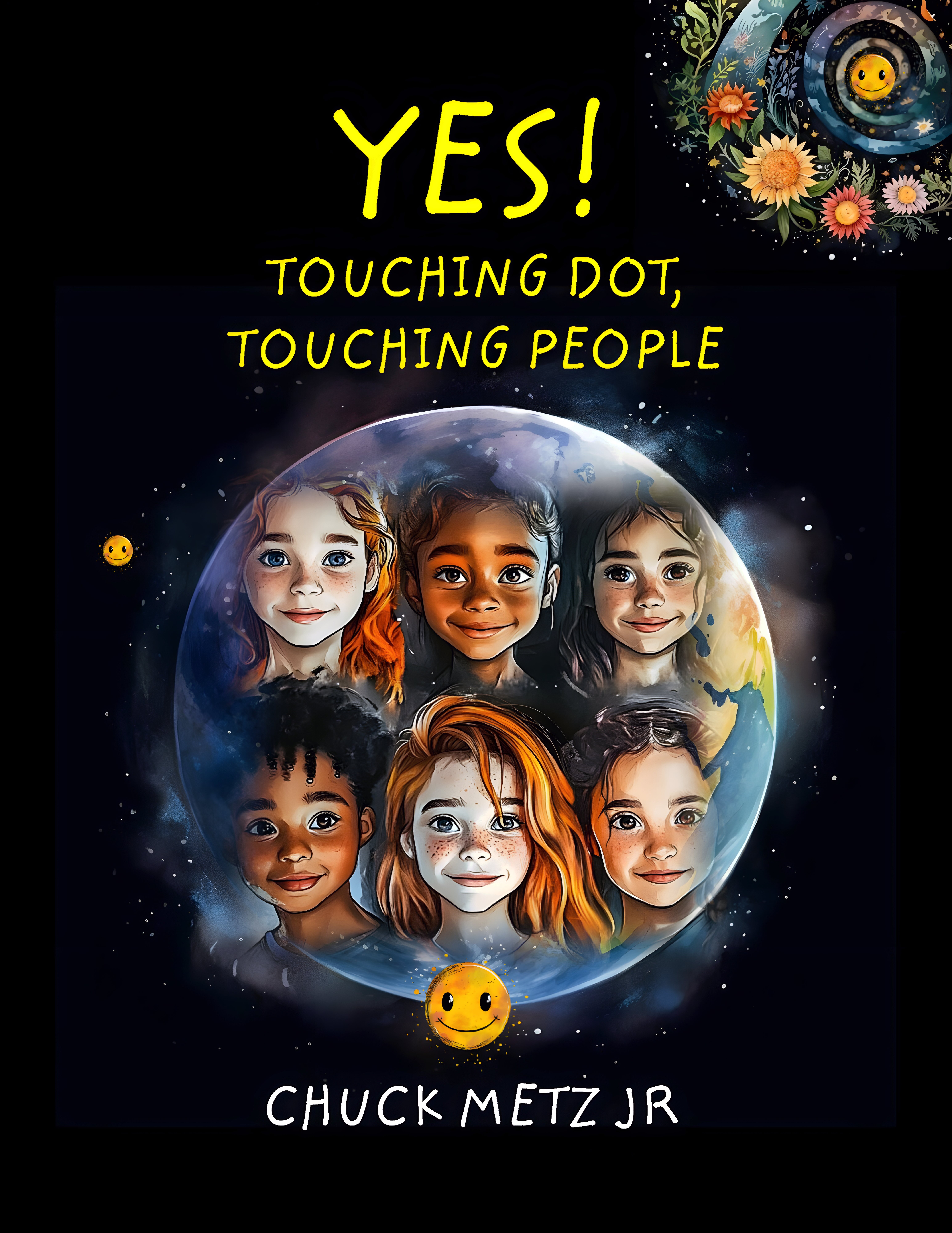
YES! Volume 2 Released

A new character joins DOT! Meet Olivia. Together, she and DOT continue Volume 1’s unfolding story of IS! is BETTER than NOT IS! And what a story they tell. YES! Touching DOT, Touching People examines the age-old question, “Why do people hurt each other?”

In this day of cultural conflict, rampant misinformation, and polarized disagreement on fundamental human values, DOT continues her message of reconciliation. A new saying enters the YES! world in Volume 2 – There is no THEM. There is only US…BROKEN. Olivia joins DOT in examining the evolutionary history underlying human conflict as the book explores cultural conflict’s NOT IS! role. People share more in common than the cultural differences between them. And on those fundamental human values, cultures can flourish in their unique beauty and diversity.

In pursuit of that, Olivia offers hope, explaining simple actions that children can take that enable them to feel more control in an uncertain world. Through “superpowers” and tools, children learn how to make a difference wherever they live.

Volume 2 is available now at https://www.amazon.com/YES-Touching-Dot-People/dp/B0DJBW5T7Y!

Which is the Hardest to Change: People, Institutions, or Technology?

Ranking and Analysis of Difficulty: Emotions, Institutions, Technology

Let’s look at a very simple exercise. If we wanted to bring people with their evolutionary wiring, cultural differences, personality varieties, and vastly different upbringings; along with their seemingly unending types of institutions, into balance with our human technological development – which would be most difficult?

1. Institutions: Most Difficult to Change

Rationale:
Institutions are deeply entrenched systems that embody the cumulative historical, cultural, and political legacies of societies. They are resistant to change due to their structural and systemic nature, which is often reinforced by powerful interests and the inertia of established norms and practices. The complexity of institutional reform is evident in the challenges of addressing neoliberal reforms in higher education, where entrenched interests and historical legacies complicate transformative change[2]. Furthermore, institutions like global health systems exhibit profound resistance to change, influenced by political, economic, and social factors that are deeply embedded within national and international power structures[12].

Factors Contributing to Difficulty:

  • Entrenched Interests: Institutions often benefit certain groups who have vested interests in maintaining the status quo, making reform challenging.
  • Complexity of Systems: Institutions are complex systems with many interdependent parts. Changes in one area can have unforeseen consequences in others, requiring careful planning and broad consensus.
  • Cultural and Historical Inertia: Many institutions are rooted in historical and cultural contexts that lend them legitimacy and durability, making radical changes culturally and politically sensitive.

2. Emotions: Moderately Difficult to Manage

Rationale:
Emotions are inherent to human nature and are shaped by evolutionary processes that are not easily rewired. While individuals can learn to manage and regulate their emotions through techniques such as mindfulness and cognitive-behavioral therapy, the fundamental nature of emotional responses remains a constant challenge. The evolutionary ecological model highlights that emotions, such as fear and anxiety, have developed as adaptive responses to environmental threats, making them deeply ingrained in human behavior[10].

Factors Contributing to Difficulty:

  • Biological Basis: Emotions are rooted in the human brain’s architecture, which has evolved over millennia. Changing these hard-wired responses requires significant and sustained psychological intervention.
  • Individual Variability: Emotional responses vary widely among individuals, influenced by genetics, upbringing, and personal experiences, complicating broad-based management strategies.
  • Adaptive Function: Many emotions serve adaptive functions that enhance survival and reproduction, making them essential despite their sometimes-negative effects on modern life.

3. Technology: Least Difficult to Innovate

Rationale:
Technology evolves rapidly, driven by continuous advancements in science and engineering. The pace of technological change is inherently faster than that of emotional evolution or institutional reform, as seen in the ongoing developments in digital media and artificial intelligence[4]. Technological innovation is often embraced because of its potential to improve efficiency, productivity, and quality of life.

Factors Contributing to Ease:

  • Rapid Innovation Cycle: Technology sectors are characterized by rapid innovation cycles that continually produce new and improved products and systems.
  • Market Dynamics: The technology market is driven by competition and consumer demand, which incentivize constant improvement and adaptation.
  • Scalability: Technological solutions can be rapidly scaled and adapted across different contexts and geographies, unlike emotional interventions or institutional reforms that require tailored approaches.

Conclusion

In summary, institutions present the greatest challenge due to their complex, entrenched nature that resists rapid change. Emotions, while more malleable, are still difficult to manage universally due to their deep biological and adaptive roots. Technology, in contrast, evolves quickly and is continuously shaped by market forces and innovation, making it the least difficult to advance among the three. This analysis underscores the importance of addressing each area with strategies that are appropriate to their specific challenges and dynamics.

We are going to look at this issue from many different perspectives. And we’ll be bouncing dialogue from large language model AIs, usually Perplexity as it cites better for now in my opinion. Regardless, think of it as brainstorming ideas with part of our human informational database. – not someONE. Perplexity is an assistant digging for information. Not a sentient AI or even close for now. But a useful tool. And as always, what it chooses to cite is always fascinating, whether or not I would agree.

So, Perplexity’s conclusion indicates institutions. Simplistic for the moment but illustrating the problem. Which would you choose?

Citations:
[1] https://academic.oup.com/book/43098/chapter/361570262
[2] https://www.mdpi.com/2076-0760/9/5/79
[3] https://chalmers.org/resources/blog/a-biblical-framework-for-poverty-the-four-key-relationships/
[4] https://digitalcommons.cedarville.edu/cgi/viewcontent.cgi?article=1010&context=christian_engineering_conference
[5] https://orionmagazine.org/article/dark-ecology/
[6] https://www.vatican.va/roman_curia/pontifical_councils/justpeace/documents/rc_pc_justpeace_doc_20060526_compendio-dott-soc_en.html
[7] https://papers.ssrn.com/sol3/papers.cfm?abstract_id=3578575
[8] https://philarchive.org/archive/JONTRO-26v2
[9] https://www.pewresearch.org/internet/2023/02/24/expert-essays-on-human-agency-and-digital-life/
[10] https://www.ncbi.nlm.nih.gov/pmc/articles/PMC7324729/
[11] https://www.ncbi.nlm.nih.gov/pmc/articles/PMC7215339/
[12] https://www.ncbi.nlm.nih.gov/pmc/articles/PMC7458571/
[13] https://www.ncbi.nlm.nih.gov/pmc/articles/PMC10729319/
[14] https://quizlet.com/98830550/chapter-10-flash-cards/
[15] https://www.accc.gov.au/system/files/ACCC%2Bcommissioned%2Breport%2B-%2BThe%2Bimpact%2Bof%2Bdigital%2Bplatforms%2Bon%2Bnews%2Band%2Bjournalistic%2Bcontent,%2BCentre%2Bfor%2BMedia%2BTransition%2B%282%29.pdf
[16] https://www.amazon.com/Following-Jesus-Digital-Jason-Thacker/dp/1087754593
[17] https://www.jstor.org/stable/23019520
[18] https://www.pnas.org/doi/10.1073/pnas.1620732114
[19] https://www.cde.ca.gov/ci/hs/cf/documents/hssframeworkwhole.pdf
[20] https://files.eric.ed.gov/fulltext/ED618290.pdf

Balance the Triangle

This Perplexity summary touches on a few of the high points regarding balancing Wilson’s issues:

The real problem of humanity is the following: we have paleolithic emotions; medieval institutions; and god-like technology. And it is terrifically dangerous, and it is now approaching a point of crisis overall.

E. O. Wilson

Introduction

The quote attributed to Edward O. Wilson encapsulates a profound challenge facing contemporary society: the discordance between our evolved emotional responses, our historical and often outdated institutional frameworks, and the exponential growth of our technological capabilities. This dissonance has the potential to precipitate crises across various domains, from environmental degradation to social inequality, and from ethical dilemmas in science to the erosion of democratic processes. To address this, a multidisciplinary methodology that promotes balance among these three elements is essential. This approach would involve the integration of insights from evolutionary psychology, social and political sciences, and technology and information studies.

Evolutionary Psychology and Emotion Regulation

Understanding Paleolithic Emotions

Our emotional responses, while having served us well in the Paleolithic era, may not always be suited to the modern world. Fear, aggression, and tribalism, for example, can lead to conflict in a globally interconnected society. Evolutionary psychology can help us understand these primal emotions and their triggers.

Strategies for Emotion Regulation

To mitigate the impact of these emotions, we can develop strategies for emotion regulation. This includes mindfulness practices, cognitive-behavioral techniques, and educational programs that focus on emotional intelligence. These practices can help individuals recognize and manage their emotional responses in a way that is more aligned with the complexities of contemporary life.

[My note: There are many other human behaviors we will discuss.]

Reforming Medieval Institutions

Assessing Institutional Relevance

Many of our institutions, from legal systems to educational structures, have roots in medieval or even earlier times. A critical assessment of their relevance and effectiveness in the modern world is necessary. This involves questioning whether these institutions serve the public good or perpetuate outdated power dynamics.

Institutional Evolution

Institutions must evolve to reflect contemporary values and knowledge. This can be achieved through reforms that incorporate principles of equity, transparency, and adaptability. For example, modernizing the education system to include critical thinking and digital literacy can prepare individuals to navigate the complexities of the modern world.

[Ditto for institutions]

Harnessing God-like Technology

Ethical Frameworks for Technology

The rapid advancement of technology, particularly in fields like artificial intelligence and biotechnology, presents ethical challenges that our current frameworks may not adequately address. Developing robust ethical guidelines that consider long-term impacts and the rights of all stakeholders is crucial.

Technology for Social Good

Technology should be harnessed to address societal challenges rather than exacerbate them. This involves directing research and development towards sustainable practices, equitable access to resources, and technologies that promote social cohesion.

Integrating the Three Elements

Interdisciplinary Collaboration

Balancing paleolithic emotions, medieval institutions, and god-like technology requires interdisciplinary collaboration. Psychologists, sociologists, ethicists, technologists, and policymakers must work together to create integrated solutions that consider the emotional, institutional, and technological aspects of challenges.

Public Engagement and Education

Public engagement and education are vital in this process. By increasing public understanding of these issues, individuals can make informed decisions and demand accountability from institutions and technology developers.

Continuous Evaluation and Adaptation

Finally, a system of continuous evaluation and adaptation must be in place to ensure that the balance among emotions, institutions, and technology remains aligned with the public interest. This involves regular reassessment of policies, educational curricula, and technological impacts.

[And ditto once again. But this tees a simple summary.]

Conclusion

Creating a better world in the face of the discordance between our ancient emotions, outdated institutions, and advanced technology requires a comprehensive and multidisciplinary approach. By understanding and regulating our emotional responses, reforming institutions to reflect modern values, and developing ethical frameworks for technology, we can work towards a more balanced and sustainable future. Interdisciplinary collaboration, public engagement, and continuous adaptation are key to this endeavor.

Citations:
[1] Medieval Perspectives on the Modern Problem of the “Global Middle Ages … https://brill.com/view/journals/me/29/2-3/article-p285_7.xml?language=en
[2] The medieval power struggles that helped forge today’s universities https://theconversation.com/the-medieval-power-struggles-that-helped-forge-todays-universities-54298
[3] Edward O. Wilson – Oxford Reference https://www.oxfordreference.com/display/10.1093/acref/9780191826719.001.0001/q-oro-ed4-00016553
[4] Medieval and Early Modern Challenges | Our Lady of Dallas https://abbey.cistercian.org/history/the-cistercian-order/medieval-and-early-modern-challenges/
[5] Public Humanities and the Future of Medieval Studies – Notre Dame Sites https://sites.nd.edu/manuscript-studies/2021/12/22/public-humanities-work-in-the-field-of-medieval-studies/
[6] Developing Standards | Public History Initiative – UCLA https://phi.history.ucla.edu/nchs/preface/developing-standards/
[7] Current Challenges and Future Trends in Medieval Studies https://medievalstudies.ceu.edu/current-challenges-and-future-trends-medieval-studies-0
[8] Social change | Definition, Types, Theories, Causes, & Examples https://www.britannica.com/topic/social-change
[9] Prehistoric Emotions in the Modern World https://artsci.washington.edu/news/2014-08/prehistoric-emotions-modern-world
[10] What problems back in medieval times (or problems in general) would be … https://www.reddit.com/r/DnD/comments/pofxhk/what_problems_back_in_medieval_times_or_problems/
[11] Our Brains Are No Match for Our Technology – The New York Times https://www.nytimes.com/2019/12/05/opinion/digital-technology-brain.html
[12] Quote by Edward O. Wilson: “The real problem of humanity is … – Goodreads https://www.goodreads.com/quotes/9770741-the-real-problem-of-humanity-is-the-following-we-have
[13] Integrating Multiperspectivity in the History Classroom https://www.coe.int/en/web/observatory-history-teaching/-/integrating-multiperspectivity-in-the-history-classroom
[14] The Lifespan Perspective | Lifespan Development – Lumen Learning https://courses.lumenlearning.com/wm-lifespandevelopment/chapter/the-lifespan-perspective/
[15] We Have Paleolithic Emotions, Medieval Institutions, and Godlike … https://www.linkedin.com/pulse/we-have-paleolithic-emotions-medieval-institutions-godlike-wang
[16] Social Integration Definition, Theory & Types – Lesson – Study.com https://study.com/academy/lesson/social-integration-definition-theory.html
[17] What Is Human Nature? Paleolithic Emotions, Medieval Institutions … https://bigthink.com/hard-science/eo-wilson-what-makes-us-human-paleolithic-emotions-medieval-institutions-god-like-technology/
[18] Timing is everything: Developmental changes in the associations … – NCBI https://www.ncbi.nlm.nih.gov/pmc/articles/PMC10552862/
[19] Paleolithic Brains and God-like Technology – Coalition for Trust in … https://trustinhealthandscience.org/paleolithic-brains-and-god-like-technology/

CHANGES TO THE SITE

Changes are in the works.

Children’s blog posts and other age-appropriate materials can be viewed by clicking the YES! button in the top menu. Parents and children can click on that button to access those resources.

The same for the Balance the Triangle posts – click the appropriate button in the top menu.

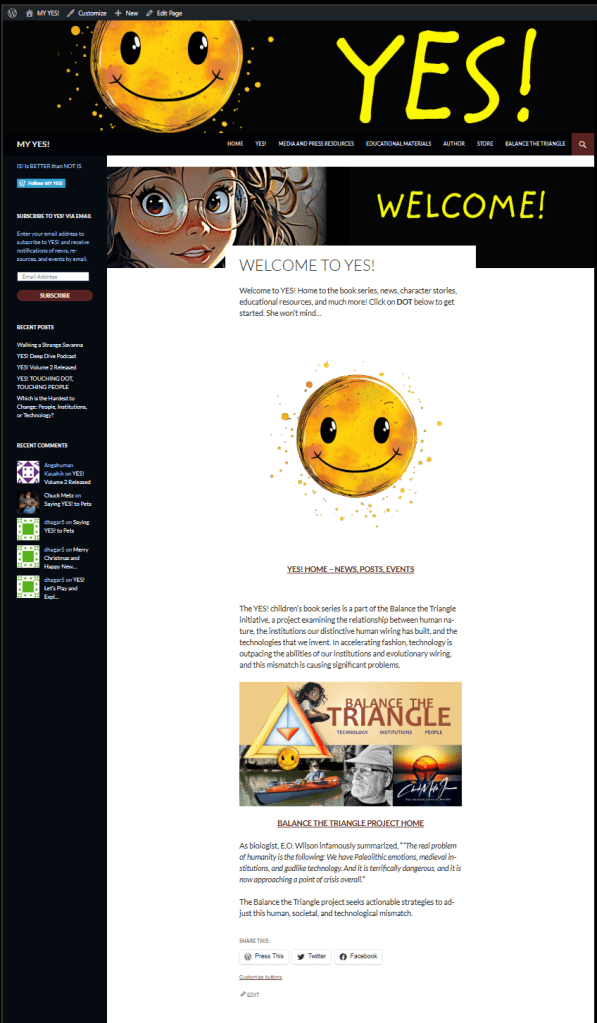
The HOME page is now home to both Balance the Triangle, the parent initiative of the children’s YES! books and resources, and the YES! project. On either the HOME or Balance the Triangle pages, you will be able to follow more in-depth discussions of the ideas wrapped up each month in the LinkedIn Balance the Triangle newsletter, as well as related materials that don’t make the newsletter. Click on either image on the Home Page or use the top menu buttons to go to either page individually.

The LinkedIn newsletter will continue exactly as it has done for the past year and a half. This site augments that effort.

We all want a better world for our children. And so, we continue that delicate balance of human nature, the institutions we build, and the technologies we create. We owe our children that better future.

Thanks to all for their interest in this project.

Saying YES! to Pets

Saying YES! to your pets is a discovery in how these furry, feathery, or even scaly friends can fill our hearts with joy and love. Whether you have a pet, dream of having one, or just love animals, this journey is for you!

A Furry Bundle of Joy!
Imagine coming home from school, and who’s there to greet you with a wagging tail or a happy chirp? Your pet! Pets are not just animals; they’re like family members who share our lives and homes. They can be dogs, cats, birds, fish, rabbits, or even turtles! Each one has its own special way of bringing happiness into our lives.

Pets Make Us Smile 😊
Have you ever played fetch with a dog or watched a kitten chase a ball of yarn? It’s so much fun and can make you laugh out loud! Pets do the silliest things that can turn a boring day into a super fun one. Their playful antics are like a burst of sunshine on a cloudy day, making us feel happier and more cheerful.

A Friend Who Listens
Sometimes, we all feel a little down or have a tough day. Pets are amazing listeners. You can tell them anything, and they won’t judge or interrupt. They just sit by your side, offering comfort with their presence. It’s like having a best friend who’s always there for you, ready to lend a fluffy ear or a gentle nudge.

Learning to Care and Share
Taking care of a pet is a big responsibility, but it’s also really rewarding. Feeding them, cleaning their living space, and making sure they’re healthy teaches us how to be responsible and caring. It’s like being a superhero for your pet, making sure they have everything they need to be happy and healthy.

Pets Help Us Make Friends
Pets can be great at helping us make new friends! Walking a dog in the park or joining a pet club at school can introduce us to other people who love animals just as much as we do. It’s like having a special bond that brings people together.

The Magic of Cuddles
Did you know that petting or cuddling with animals can make you feel calm and relaxed? It’s true! Spending time with pets can lower stress and make us feel peaceful. It’s like a magic cuddle that melts away worries and brings a smile to our faces.

A Healthy Heart
Loving a pet doesn’t just make our hearts happy; it can actually make them healthier! Playing and being active with pets can keep our bodies fit. Plus, the happiness we get from being with our pets is great for our hearts, both inside and out.

A World of Love
Pets bring a special kind of love into our lives. They teach us about friendship, responsibility, and the joy of caring for another living being. Whether you have a pet or just dream of having one, remember that these wonderful animals have a lot to offer. They make our world a happier, more loving place, and that’s something truly amazing!

So, the next time you see a pet, think about all the incredible ways they make our lives better. And who knows? Maybe one day, you’ll have a furry, feathery, or scaly friend to say YES!

YES! Let’s Play and Explore the World Together!

Have you ever thought about how cool it is just to be alive and be able to play? Every time we say “YES!” to play, we’re saying yes to exploring this amazing world we live in. It’s like being on an adventure every single day!

The Magic of ‘YES!’
When we say “YES!” to play, we’re not just having fun. We’re learning, exploring, and discovering new things. Did you know that saying “YES!” is like opening a magical door to a world full of possibilities? It’s true!

Play is Like a Superpower!
Playing is like having a superpower. It helps us learn how to solve problems, make friends, and even helps us understand big ideas. When we build a fort, we’re learning about teamwork and engineering. When we pretend to be astronauts, we’re exploring space and science without even leaving our backyard!

YES! to Questions and Curiosity
Remember, it’s okay to ask questions about the world. Why is the sky blue? How do birds fly? The best part of playing and exploring is that we can ask tons of questions and find answers together. That’s how we grow our brains and our hearts!

A World of Adventure Awaits!
So, the next time you play, remember that you’re doing something really important. You’re learning about the world, making it a better place, and having a ton of fun while doing it. Let’s all say a big “YES!” to play and start our next adventure. Who knows what amazing things we’ll discover?

Remember, every day is a chance to say “YES!” to fun, learning, and adventure. Let’s make the most of it together!

ChatGPT Analysis of YES! A Quantum Song of Love

The document “YES! A Quantum Song of Love,” provides a thoughtful perspective on children’s development and communication. It highlights the vital role of children in bringing joy and renewal to the world through their innocent wonder. This perspective underscores the importance of maintaining childhood innocence for as long as possible, acknowledging that life’s difficulties will eventually impact it.

The document emphasizes a simple yet profound message: the inherent value of existence. It blends fundamental physics with messages found in various secular and religious philosophies, positing that existence is preferable to non-existence. This concept is important in children’s education as it fosters a sense of wonder and appreciation for life.

Furthermore, the text suggests that discussions around love, existence, and fundamental human values should be inclusive of our collective humanity and cultural diversity. It acknowledges the complexity of addressing pain, sorrow, and life’s challenges, advocating for open discussions informed by the diverse cultural wisdom of communities worldwide.

Significantly, the document recommends that reading aloud to children should become a dialogue between the adult and the child. This approach is not just about storytelling; it’s an opportunity to engage children in conversations about complex topics such as cultural conflict, environmental sustainability, and other contemporary challenges. This method of interaction is crucial in children’s communication and psychological development, as it encourages them to think critically and develop a deeper understanding of the world around them.

In summary, the document presents an insightful approach to children’s communication and psychology. It emphasizes the importance of preserving childhood innocence, instilling a sense of wonder about existence, and engaging children in meaningful discussions about complex global issues. This approach is beneficial for nurturing well-rounded, thoughtful, and empathetic individuals.