

All posts by Chuck Metz

The Tilt isn’t the End
I have something I brought back from Equilibria.
More than memory. More than change. Something physical, hard…and grounding.
I held that little shape in my hand today—the one they call the Gömböc. It looks like nothing special. Just a smooth, oddly cut stone. But when I placed it down crooked on the table, it shivered once, then—almost stubbornly—tipped itself upright.
No matter how I set it down, it always found its way back.
And something in me ached watching it.
Because I know what it feels like to be tilted. To be spun by grief or fear or confusion until all your angles feel wrong and your balance is lost. I’ve seen entire villages like that. Systems like that. People who never believed they could come back.
But the Gömböc doesn’t fight the tilt. It doesn’t panic.
It just remembers.
It carries its center like a secret. And no matter how the world tosses it, it returns—not because it wants to, but because it was shaped to.
That’s the lesson I think the Keepers were trying to show us.
We spend so much time trying not to fall, as if failure were final. As if imbalance means brokenness. But what if the real strength isn’t in staying upright?
What if it’s in learning how to rise, to stand again and again, until balance isn’t luck—it’s design?
The world that’s building in Equilibria won’t always stand straight.
But if it is shaped right—if we shape ourselves right—it will always know how to return.
I want to be like that little shape.
Not unbreakable.
Just unlosable.
~ Olivia
Belonging in an Age of Dehumanizing Rhetoric
Balance the Triangle examines the relationship between us, our institutions, and our technologies. The language we use shapes who we are, the institutions we create, and the technologies we build. It creates the narratives by which we flourish or fail in the societies we create.From its past subtleties, language in politics and the public forum has become more blatantly dehumanizing and divisive in the United States. As the us portion of our balance triad determines the other two legs, failure to address this trend in ourselves inevitably shapes society’s institutions and technologies. Which in turn determines whether our societies support or suppress human flourishing.
The Language of Loss
Political discourse in recent years has increasingly turned to metaphors of infestation, decay, and invasion to describe marginalized populations—most often the poor, the unhoused, the immigrant, and the addicted. This domination of the weaker is found in all cultures—a product of our evolutionary history. Its expression in American political life reduces human beings to vermin in order to erode public empathy and justify systemic neglect or punishment.
This rhetorical strategy is hardly new. It’s one of history’s oldest tricks.
From Nazi propaganda calling Jews vermin to Rwandan broadcasters describing the Tutsi as cockroaches, dehumanizing language precedes and enables violence. It shifts public perception from solidarity to suspicion, from compassion to containment. It dulls the collective conscience and divides.
Today, we experience a modern but no less corrosive version at work—one where urban decay is attributed not to structural failure or policy neglect, but to the supposed character flaws of its inhabitants.
The Real Stakes of Dehumanization: When Language Unweaves the Triangle
To reduce a person to something less than human is not simply to insult them—it is to cast them out of the moral circle. And once outside that circle, what happens to them is no longer seen as injustice, but merely inevitable.
The consequences of dehumanization are not theoretical. They are felt—in policy, in neighborhoods, and in our inner lives. When the triangle unbalances, its unraveling leaves damage in every domain.
1. Policy Hardening (Institutional Fracture)
When metaphors turn neighbors into “rats” or “infestations,” political leaders are no longer bound to serve them. Aid becomes handout. Housing becomes a threat. Infrastructure withers, not from cost, but from contempt.
In Equilibria, Olivia learned: The way you describe a person determines how you serve them. When the institution loses the ability to see citizens as sacred threads in the social weave, it frays into hierarchy and neglect.
2. Social Withdrawal (Us Fragmented)
Dehumanization erodes trust not just in leaders—but in each other. Neighbors pull inward. Conversations shrink. Fear replaces fellowship. The playground becomes a border. The streetlight, a warning.
In Equilibria, this was called Gray Seasons—when even the kindest lost the language of hello. Healing began not with programs, but with presence. Because no civic architecture stands when hearts board up their windows.
3. Normalization of Cruelty (Technological Indifference)
Technology, once a bridge, becomes a blade. Social media algorithmic feeds amplify outrage. Cruelty becomes content. Empathy—dismissed as naïveté. Compassion—mocked as weakness.
Olivia observed the buildingof social filters in Equilibria, not just to moderate speech, but torestore resonance. They trained their systems to ask not just “is it trending?” but “is it kind?” Tech aligned to moral vision doesn’t profit from dehumanization—it shields against it.
In her experiences, Olivia saw every citizen contributing to a “weave of shared becoming.” No one was irrelevant. The moment a person is cast out by language, the entire tapestry weakens. Weaving in Equilibria parallels—and is a metaphor—for society.
Reclaiming Belonging Means…
To reclaim belonging is not to return to a past where everyone felt safe—it is to forge a future where no one is made invisible.
It is not a project of nostalgia, but of design—an act of collective threading, where every voice strengthens the weave and every name is called with care.
1. Naming the Harm (Us)
We begin with our mouths. Dehumanization doesn’t always shout. Sometimes it sighs.
When we call a neighborhood a “war zone,” we imply its residents are combatants. When we call people “drains,” we forget that systems fail people—not the reverse.
Reclaiming belonging means resisting these metaphors—even in private thought. Especially in policy, media, or pulpits. Language is how we decide who belongs and who is managed.
In Equilibria, Olivia learned that silence in the face of degrading speech is not neutrality—it is erosion.
2. Centering Human Stories (Institutional)
Systems love statistics. But people live in stories.
To craft policies without hearing the lives beneath them is to build scaffolding on sand. Reclaiming belonging means listening longer. Letting policy emerge from proximity, not presumption.
Narrative isn’t decoration. It’s how we build moral gravity.
Equilibria’s councils opened with stories—not reports. Because what touches the heart shapes the hand. And we, as human, are wired to make sense of the world through narrative.
3. Designing with Dignity (Institutional)
Community systems too often ask: “Are you worthy?” before offering help.
We must flip that question. What if dignity was assumed—not earned?
Reclaiming belonging means creating infrastructure—housing, schools, public spaces—that speaks with people, not about them. No tests of purity. No labyrinths of paperwork. Just the quiet declaration: You matter.
4. Ethical Leadership in Language (Institutional/Us)
Power speaks. So, it must learn to speak wisely.
Leaders—whether civic, spiritual, or technological—must be trained in the ethics of language. Not just what rallies a base, but what repairs a wound. Not just what wins a vote, but what builds a bridge.
Language was not just tool in Equilibria—but trust. A careless phrase could unravel months of communal care. So, leaders learned to speak as if each word carried weight—because it does.
Pathways Forward: Repairing the Weave of Belonging
Each act of dehumanization tears at our collective fabric. But the fabric can be rewoven—thread by thread, action by action. In Equilibria, such repairs are not responses to crisis, but the daily maintenance of a shared life. These pathways offer ways to reclaim belonging across all corners of the triangle: Us, our Institutions, and our Tools.
1. Mutual Aid Networks (Us + Institutional Interface)
Decentralized and relational, mutual aid reframes need as a shared condition rather than a flaw. It is not charity—it is community in motion.
Where traditional aid often reinforces hierarchies, mutual aid dismantles them. There are no deserving poor or undeserving others—only neighbors with different needs at different times.
Religious and secular groups alike have long carried the DNA of mutual aid. But we must not confuse institutional scaffolds with the failures of those who misuse them. The values—compassion, solidarity, reciprocity—endure, even when people falter.
In Equilibria, mutual aid is a baseline practice. No forms. No suspicion. Just exchange—warm bread left at the door; skill traded for care. It is the cultural immune system that resists the corrosion of transactional living.
2. Participatory Budgeting (Institutional)
This model shifts decision-making back to the people most affected by those decisions. It says: You know what your community needs. Let us build it together.
Instead of far-off officials or unaccountable boards, participatory budgeting lets residents propose, deliberate, and vote on how to allocate public funds—whether for park restoration, mental health services, or harm reduction.
It is democracy rehydrated. And it is belonging made visible.
In Equilibria, every neighborhood hosts a seasonal budgeting festival—part civic process, part celebration. Children paint murals beside budget proposals. Elders advise from benches. People protect what they help create.
3. Narrative Journalism Initiatives (Us + Institutional)
We make sense through stories. And too often, the stories that shape our systems exclude the people most affected by them.
Narrative journalism restores dignity where statistics flatten it. Story circles, place-based oral history projects, and first-person reporting help reframe the dialogue—not around problems, but around people.
Policy does not proceed in Equilibria without a narrative review. Every new law must include the voice of someone it would touch. Because decisions made without stories are decisions made without soul.
4. AI-Powered Empathy Filters (Technological + Cultural Mediation)
Words form worlds. And so, we build tools to guard them wisely.
Emerging empathy filters, powered by language models, scan for patterns of metaphor, analogy, and framing that echo historical harm. They do not censor—they invite reconsideration.
Imagine a news editor writing, “invasion of the homeless,” and receiving a gentle prompt: “Would you consider: ‘a surge in need’ or ‘a growing population left without options’?”
In Equilibria, these filters are woven into civic media platforms. Not to control speech—but to cultivate clarity and compassion.
Because wise speech is not fragile. It is intentional.
Final Words
To describe someone as vermin is not just to insult them—it is to remove them from the moral circle. What follows is not a debate, but a dismissal. Not reform, but retribution.
If we wish to preserve any vision of shared democracy or solidarity, we must reclaim the words we use for one another. Because what we call people determines what we do to them.
And what we do to them, ultimately, becomes what we do to ourselves.
References:
See the nice piece by
Paul Krugman. “We’re All Rats Now.” The Paul Krugman Reader, July 2025. Link

Why I Gave Olivia a Voice
“There are things I remember that I never lived. Some come to me like breath; others, like fire.”
Olivia
Olivia’s Journal
Some of you have already met Olivia. Most of you haven’t. Not yet.
Olivia’s Journal is one of the writing efforts from the Balance the Triangle project. A project I originated to explore human flourishing through questioning the disconnects between us, our institutions, and our technologies. I’ll be sharing more about that effort over time.
In her journal, Olivia carries the ache and the hope of a world in an age of fracture. And, like many of you, I’ve felt that fracture. The divide between what we know and what we are. Between futures we hope for and institutions that stumble.
I didn’t initially set out to write either the ‘YES!’ books or the upcoming Equilibria series. I set out to make sense of a world with too much noise, too little clarity, and too little space for moral language without ridicule.
My name is Chuck. And I gave Olivia a voice because I needed to hear what I could no longer see.
Why I’m Writing on Substack
I came to Substack because I appreciate the depth of this community. And I wanted to add Olivia’s voice to discussions there.
Because I believe in fundamentals. That we are more than algorithms of fear and attention. That we are people wired for care, fairness, courage, reciprocity, and more. And that we still remember how to choose wisely—not just for ourselves, but for each other.
And I believe that stories—good stories, questioning stories, and even wild and trembling stories fraught with powerful emotion, might be the only things strong enough to survive the storms swirling around us. Because we are all sense-makers, who make sense of the world through the stories we tell ourselves and each other.
What Comes Next
This newsletter isn’t just Olivia’s story. Hers is one voice. An emotional compass, if you will. Mine is another. Exploring moral wounds. Emotional hurts. Cognitive lies—and ways forward. Pondering tools and theories promising a redesign of what’s broken. Struggling with this “wicked problem” around the human wiring. cultural institutions and technologies so rapidly outgrowing our management abilities. A triangle we struggle to bring into balance.
So, a couple of times a week, Olivia raises questions through her Journal. Other times, I grapple with and learn what it means to be human. And I share that journey.
When I’m not here, you can find me—and further information—on LinkedIn.
It’s no easy task. Many others fight in these trenches. I add my voice and Olivia’s to their efforts.
Thanks for listening.
Take a look at Olivia’s reflections in her Journal on her Substack page.
THE SILENCE AFTER WHITE SMOKE
Yesterday, a new Pope was chosen.
For a moment, the bells rang, and the sky filled with white breath —
smoke rising like a prayer across rooftops that have seen centuries of waiting.
They named him Leo the Fourteenth.
But before he spoke, there was silence.
And in that silence, I imagined the weight settling on his shoulders —
the weight of history, of souls, of choices yet to be made.
In Equilibria, there’s a tree called the Witness Cedar.
It grows on the edge of the Whispering Bluffs,
where winds carry voices from across the valley below.
The Keepers say the tree listens.
And once every generation, someone climbs to carve a single word into its bark —
a choice meant to guide those who come after.
Some words are bold: Justice. Courage. Flame.
Others are soft: Listen. Mourn. Begin.
The new Pope, they say, was once a quiet man who walked with villagers in Peru.
Now he walks into the center of a world that waits to be answered.
I wonder what word he’ll carve.
And I wonder, too, what words we are all carving —
in how we lead, in what we bless, in who we stand beside.
Because choosing isn’t always about power.
Sometimes, it’s about knowing that someone will follow your footsteps
and trying, gently, to leave the ground more whole than you found it.
If we could carve only one word into the world right now,
what would we choose —
and who would it carry?
The Bread We Forget
I just read that in Sudan, millions of people are facing hunger so deep it hollows out their days and dreams.
Children walk for hours just for a handful of grain, mothers barter scraps of cloth for a crust of bread.
The headlines call them “displaced populations,” — but they have names, memories, laughter that once rang out across open fields.
I had to close my eyes for a moment because the ache felt too big.
In Equilibria, we once visited a village that had fallen into imbalance after a long drought.
The River Breath had shrunk to a trickle, and the gardens dried to brittle husks.
At first, the villagers argued — some blaming the hills, some blaming the wind, some blaming each other.
But the Keeper Elder, Mara, taught us: “When the roots are broken, it does no good to shout at the leaves.”
Because we are all one tree.
She gathered everyone — not to punish, but to plant.
Each family was given one seed and a share of the village’s last water to tend it.
It wasn’t enough to fix everything at once. But it was enough to begin mending.
Sometimes, looking at the brokenness of the world, it’s easy to believe it belongs to someone else.
Easy to think we are standing apart, untouched.
But suffering is not their burden. It is ours.
Every child crying for bread tears a small hole in the fabric that binds us all together.
I learned from DOT that there is no THEM. Whether civil war, as in Sudan, natural disasters like Equilibria’s, or other causes, “displaced populations” are only US…broken.
All of us.
If we do not answer the hunger of another heart, how long before we forget the taste of kindness ourselves?
OLIVIA’S JOURNAL
Breath Beneath the Stones
Today I read a story about a team of scientists exploring the Atacama Desert in Chile — one of the driest places on Earth.
They found tiny, stubborn life: microbes clinging to the underside of quartz rocks, where just enough moisture gathers to survive.
Whole invisible worlds, breathing under stones, unseen by almost everyone.
It made me stop and hold my own breath for a moment.
I remembered the hidden groves near the Breath Lakes in Equilibria.
There, small silver-rooted plants grew only in the shadows between boulders, where the mist would drift just long enough to leave a kiss of water.
We called them the Whisperlings.
DOT taught me that they existed because of one thousand nearly-invisible balances — the angle of the stone, the way the wind curled, the patience of waiting for the mist.
No one force alone kept them alive. It was everything, all at once, carefully holding its breath.
I wonder how often we forget that most of life is like that — surviving in the fragile spaces we rarely notice.
It’s easy to look at the big things — mountains, oceans, cities — and believe they’re what matter most.
But maybe it’s the unseen breath beneath the stones that keeps the world alive.
What other quiet miracles are we stepping over every day without even seeing them?

New Instagram Channel
Olivia tells her view of events on Instagram. She shares perspectives, backstories, and more for a unique look at the world of YES!
Scan the barcode below or go to https://www.instagram.com/yesbookseries/


Walking a Strange Savanna
OVERVIEW
The world we inhabit today is both familiar and strange. It teems with life, connection, and possibility, yet it feels unsteady, as if the ground beneath us has shifted. We find ourselves in a moment of profound transformation, shaped by forces we only partially understand—forces of our own making.
On one level, this story is deeply familiar. For millennia, humans have faced challenges born of the mismatch between who we are and the worlds we create. We are a species hardwired for small groups and simple tools, navigating a global, digital civilization of billions. Our minds were forged in the scarcity of the Paleolithic, yet we now contend with the paradox of abundance. Our institutions, designed for slower, more predictable eras, falter under the weight of exponential change. And our technologies, which amplify both our wisdom and our folly, demand a level of foresight we have barely begun to develop.
On another level, this story is entirely new. Never before have the stakes been so high or the opportunities so immense. The choices we make today will shape the lives of billions—and the legacy of humanity—for generations to come. Will we navigate this strange new savanna with the wisdom it demands? Or will we stumble, weighed down by the mismatches of our wiring, the inertia of our institutions, and the blind spots of our technologies?
This book is an invitation to explore these questions. It is a journey through the forces that shape our world—human nature, societal structures, and technological systems—and how they interact in ways that often seem chaotic, even overwhelming. But it is also a journey of hope. For as much as humanity is defined by its flaws, it is also defined by its capacity to adapt, to learn, and to create.
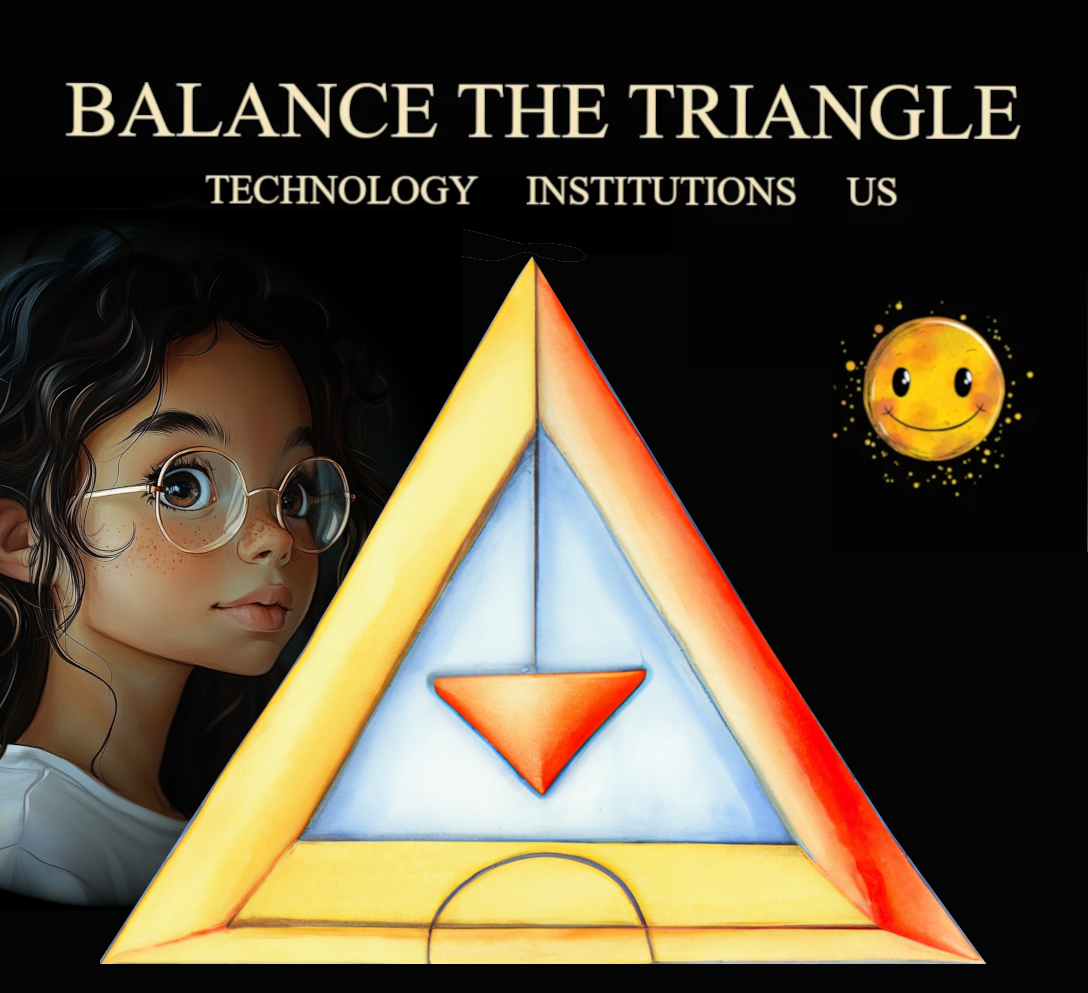
The framework at the heart of this book—Balance the Triangle—offers a way to understand and address the tensions of our time. It begins with three elements:
Human Wiring: The instincts and behaviors that have guided us for tens of thousands of years.
Institutions: The systems and structures that channel those instincts into collective action.
Technology: The tools that magnify our abilities and reshape our environment.
When these elements are in harmony, humanity flourishes. When they fall out of balance, we face conflict, stagnation, and collapse. The digital age has pushed this Triangle out of alignment, but it has also given us the tools to restore it.
This book is written for those who shape the world—leaders, innovators, thinkers, and doers. It is for anyone who feels the dissonance of the present moment and wonders how we might resolve it. It draws on insights from evolutionary psychology, philosophy, technology, and history, but its purpose is practical: to chart a path toward a world where humanity thrives, not just survives.
Throughout these pages, we will explore the past to understand how we arrived here, examine the present to confront our challenges, and imagine the future to envision what we might become. This is not a book of easy answers but a call to engage with the complexity of our time—and to act.
The strange savanna we walk today is not without its dangers, but it is also rich with promise. Together, we can find our way, guided by the lessons of the past and the vision of a better future.
Let’s begin.

YES! Deep Dive Podcast
Take a listen to a Notebook AI-generated podcast around the first three volumes of the YES! series. Volumes 1 and 2 are on Amazon. Volume 3 is due up shortly! The podcast is auto generated from the book texts and the analysis is striking for a new AI product….
 MY YES!